
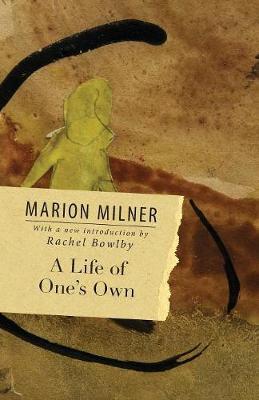
I can’t believe it took me so many years to discover Marion Milner (via Adam Phillips) — an English psychotherapist born more than a century ago but so accurately speaking my mind. Almost devoured her first book — a diary she kept for seven years from age 27, with the sole purpose of catching daily “highlights” in order to see “whether I could discover any rules about the conditions in which happiness occurred”.
What she found, with her intense gaze both into and outwards herself, was much greater and profounder than that — it’s a method “for discovering one’s true likes and dislikes, for finding and setting up a standard of values that is truly one’s own and not a borrowed mass-produced ideal”. For what’s really easy, is to “blind one’s eyes to what one really likes, to drift into accepting one’s wants ready made from other people, and to evade the continual day to day sifting of values.” It’s not easy to know just what one’s self is; it’s far easier to want what other people seem to want and then imagine that the choice is one’s own.
Throughout the experiment, the emphasis on ”lived experience” rather than mere “intellectual understanding” very much echos my own findings, which only came painfully and slowly. “It took me years to learn that I must never begin my search by looking in books, never say, ‘I know too little, I must read some more before I start,’ but that I must always observe first, express what I observed, and then, if I needed it, see what the books had to say.”
The act of seeing is more important than what’s seen. The act of looking itself changes the significance of what is observed, and the significance itself may only be found long after the event or its first recording. There are a multitude of ways of perceiving, ways that are controllable by “what I can only describe as an internal gesture of the mind” — a great phrase to describe finessing those small movements of the mind. One of the gestures she described was — “simply to press my awareness out against the limits of my body till there was vitality in all my limbs and I felt smooth and rounded”. This is learning by the senses, not by the head — “let the senses roam unfettered by purposes” and “feel its ‘thingness’ and the thrust of its shape”.
“I want, not knowledge, but experience of the laws of things, to suffer them, not only to observe them. To apprehend with regard to things I come across – the necessity of their being, what immutable laws make them what they are, their physics and chemistry and actuality, to feel it…Knowing is no good unless you feel the urgency of the thing. Maybe this is love; your being becomes part of it, giving yourself to it.”
Many observations on her roaming thoughts and how to deal with it. “Leave it free to follow its own laws of growth, my function being to observe its activities, provide suitable material to enchannel them, but never to coerce it into docility.” “I must never push my thoughts nor let it drift. I must simply make an internal gesture of standing back and watching, for it was a state in which my will played policeman to the crowd of my thoughts, its business being to stand there and watch that the road might be kept free for what ever was coming.”
“So I began to have an idea of my life, not as the slow shaping of achievement to fit my preconceived purposes, but as the gradual discovery and growth of a purpose which I did not know,” She writes. “It will mean walking in a fog for a bit, but it’s the only way which is not a presumption, forcing the self into a theory.”
“I could only get the most out of life by giving myself up to it… I began to want intensity, not extensity, to look for quality, not quantity, in living.” More concretely, she wanted to “plumb to the depths of human experience” and to “make discoveries about human beings, to know what they are.”
 Gracefulrock's Blog