
The original reason why I chose journalism over others as my profession some 20 years ago was, back then, I was convinced by means of which I could access Truth. Or at least Knowledge. I have a very different take regarding that matter now, and the rereading of Gaye Tuchman’s “Making News — A Study in the Construction of Reality” secured the final nail on the coffin. It explodes the news professionals’ clam to produce veridical accounts of social life.
The central idea here is representation and how it comes about. Just like (good) maps are only representative of terrains but not terrains themselves, news also belongs to the category of representation, or in author’s word: frame. The view seen via the frame depends on the placement, size and nature of the frame. Frames turn mere occurrences into a discernible event. Frames organize strips of the everyday world. Frames both produce and limit meaning. This reveals the vulnerability of streams of experience to framing devices. “Events” are codified apart from the contexts in which they originally developed — this very procedure thus renders phenomena as objective historical givens, giving them “the taken-for-grantedness” quality.
News makes claim to truth, or at least facticity, via method that can be understood as “natural realism” or “naive empiricism”. Through which, the information is transformed into objective facts — facts as a normal and natural description of a state of affairs. But unlike more rigorous and reflective approaches to facticity (science, for example), newswork is a practical activity geared to deadlines. Facts must be quickly identified and neatly presented. New angles must be found the very next day to deliver what’s essentially the same, continuing thematic story. The tempo of newswork mandates an emphasis on events, not issues, because the latter are analytical by nature and don’t fit neatly into structured daily practices. Journalistic treatment of the day’s events as discrete facts obscures the structural linkages between events, and serves only to present surface reality, but not reveals any structural necessities.
The magic formula to “make news” is, members of social movements have to “assemble at an inappropriate time in an appropriate place to engage in an accordingly inappropriate activity”. Only so, it’d be categorized by institutionalized professionalism as “news-worthy”.
The institutional nature of news also obscures its non-objectiveness. News is an institutional method of making information accessible to consumers, and thus subject to institutional processes and practices. A range of happenings would be excluded as “not news-worthy” because they lie outside the professional news net routinely cast by the industry, or they don’t readily present themselves as something easily packaged in a known narrative form. “Professional practices serve organizational needs. Both, in turn, serve to legitimate the status quo, complementing on another’s reinforcement of contemporary social arrangements.”
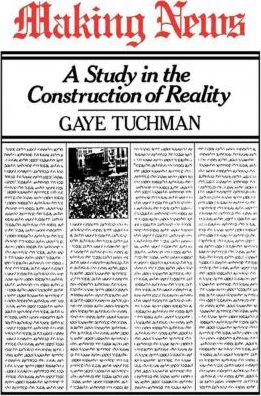
The most powerful conclusion: news as an ideology — a means not to know, a means to obfuscate social reality instead of revealing it. As an alternative form of ideology, which makes the structure of society mysterious by substituting concepts for reality, news systematically treating institutions and norms as social givens or facts. News reinforces this cognitive style of “natural attitude” — accepting the “objective existence” of social phenomena, taking them for granted, viewing them as “normal, natural facts of life” since time immemorial. Thus robbing social actors, however implicitly or subliminally, of incentive to change or transform the status quo. And encouraging a trained incapacity to grasp the real significance of new ideas.
“News, as I have argued, is a social resource whose construction limits an analytic understanding of contemporary life,” Tuchman concludes. “It is valuable to identify news as an artful accomplishment attuned to specific understanding of social reality. Those understandings, constituted in specific work processes and practices, legitimate the status quo.”
But still, “my biases are preferable to yours”. Some social actors have a greater ability to create, impose and reproduce social meanings — construct social reality. Journalists are one group with more power than most to construct social reality.
 Gracefulrock's Blog